
by Roger Riffenburgh
As the Legislature prepared to pass the state budget on June 13th, Rob Lapsley, President of the California Business Roundtable, issued a statement including the following:
“California is poised to continue with near-record-breaking spending, despite economic uncertainty, especially around federal funding. The Legislature’s plan commits more than $232 billion from the General Fund, nearly $90 billion in special funds, and billions more in bond expenditures, all while the state continues to face a chronic structural deficit of $10 to $20 billion in the General Fund and billions more in special funds.
“What we are seeing is a budget built not on discipline, but on the assumption that taxpayers—especially the business community—will continue to foot the bill for years of overspending by this Legislature.”
“Higher business taxes don’t just affect employers. They raise the cost of goods, services, housing, and utilities—exacerbating the very cost-of-living crisis that state leaders claim to be addressing. California already ranks among the most expensive states in the nation.”
The Business Roundtable provided a graph, based on California Dept. of Finance data, which shows the dramatic increase in state spending over the last 25 years.
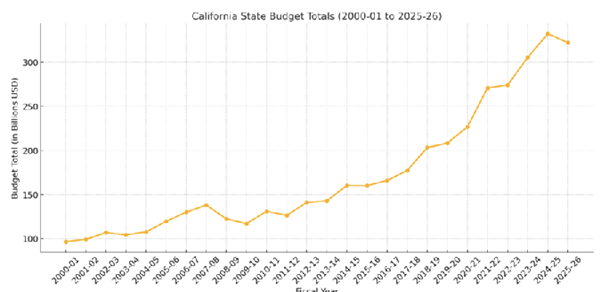
Source: California Department of Finance, Chart B, Historical Data: Budget Expenditures
————————
One might think that this was the end of the budget battle, as the state constitution requires that “The Legislature shall pass the budget bill by midnight on June 15”, but one would be wrong. After passing an initial bill, the governor and the Democrats in the legislature continued wheeling and dealing until June 30, the day before the new fiscal year starts.
Columnist Dan Walters discussed some of the results in his CalMatters article “California budget deal cooks the books again to hide big ‘structural’ deficit”. Addressing the State Senate’s claim to have stabilized and balanced the budget, he wrote, “That scenario is fictional, conjured up to mask the fact that Newsom and legislators have been overspending revenues for three years, ever since the governor erroneously declared that the state had an almost $100 billion surplus — long before fires hit Los Angeles and Trump was inaugurated.”
He says their budget “ would fill the gaps for another year with payment deferrals, loans, accounting gimmicks and raids on reserves meant to cushion the effects of genuine emergencies.”
“The accounting gimmickry takes several forms, such as delaying $2.3 billion in support payments to community colleges and local school systems that are due in June 2026 until a month later, thus shifting them from one fiscal year to another.”
“Were a private corporation to cook its books like the state government does, its executives could wind up in jail for fraud.”
Californians certainly deserve better.